CANADA HISTORY
As war erupted across Europe and North America, the French General Louis-Joseph de Montcalm quickly took the field to defend New France. In 1756, Montcalm led a successful campaign down the Lake Champlain corridor, capturing the British stronghold at Fort Oswego. This victory was crucial for the French, as it relieved the immediate threat to the lifeline of New France, the St. Lawrence River. The following year, Montcalm launched another major offensive, this time from Fort Ticonderoga against the British fort at Fort William Henry. His victories made the French seem unbeatable, as they established dominance in the early stages of the conflict. However, the French had not anticipated the strategic genius of William Pitt, who would soon turn the tide of the war.
William Pitt, Britain’s Secretary of State, understood that the key to victory in the Seven Years' War was global strategy, particularly in North America. He recognized that the French could be defeated by targeting key locations rather than trying to match French forces on all fronts. In 1758, Pitt’s grand plan was set into motion with a three-pronged British attack aimed at Ticonderoga, Louisbourg, and Fort Duquesne. At Ticonderoga, Sir James Abercrombie led several assaults on Montcalm's position, but the French fort held firm. However, while Abercrombie's attack stalled, Colonel John Bradstreet successfully destroyed Fort Frontenac, a major French supply base on Lake Ontario. This effectively cut off French forces in the Ohio Valley, leading to the abandonment of Fort Duquesne and the entire Mississippi Basin by the French.
 Simultaneously, a British naval assault on Louisbourg, a formidable fortress on Cape Breton Island, struck with devastating force. The British Navy’s overwhelming firepower reduced Louisbourg’s once-impenetrable walls to rubble, and General James Wolfe landed troops behind the fortress, forcing its surrender. The fall of Louisbourg was a critical turning point, as it opened the sea lanes up the St. Lawrence River, allowing the British to strike at the heart of New France. The gateway to Quebec City, the seat of French power in North America, was now open.
With the fall of Louisbourg, Montcalm had no choice but to retreat to Quebec, the last stronghold of New France. He left a token force at Fort Ticonderoga to delay the British advance, but his focus shifted to the defense of Quebec. By this point, the conflict had escalated into a full-scale European-style war, where large, well-organized armies faced each other in formal battles, rather than the guerrilla-style tactics that had dominated earlier skirmishes in the wilderness. Realizing the gravity of the situation, Montcalm urgently requested 4,000 additional troops from France to defend the colony. However, the French government, overstretched by the war in Europe, refused to send reinforcements, leaving Montcalm and his forces to hold the line as best they could.
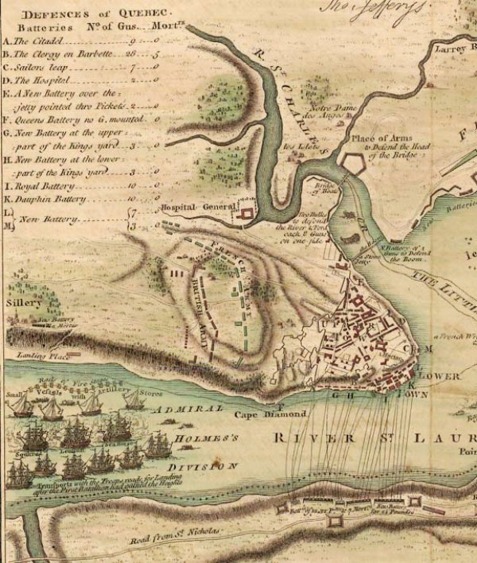
As Montcalm prepared for the British assault, Quebec City became a fortress. Canadian militia and regular French troops converged on the city to bolster its defenses. Additional artillery pieces were mounted on the city’s walls, bringing the total to 106 cannons. Defensive preparations extended to the surrounding areas, particularly to the east, where the French hoped to repel the British landing. By the summer of 1759, Montcalm had amassed 15,000 defenders, including French regulars, militia, and Indigenous allies, all bracing for the British invasion. Meanwhile, an imposing British fleet of 200 ships sailed up the St. Lawrence River, carrying 9,000 soldiers and 18,000 sailors. The fleet, commanded by Admiral Charles Saunders, supported General James Wolfe’s land forces. Wolfe was tasked with capturing Quebec before the winter set in and the river froze, which would isolate the British forces.
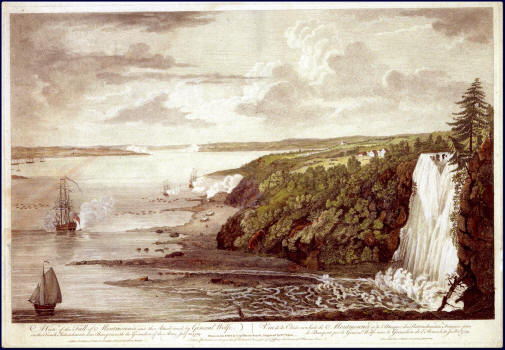
Wolfe’s first attempt to land troops at Beauport, just east of Quebec, was repelled by the French defenders, who held strong behind their fortified positions. The British assault was a costly failure, and Wolfe realized that time was running out. Winter was fast approaching, and if Quebec did not fall soon, the British would be forced to retreat before the harsh conditions of the Canadian winter. Desperate for a breakthrough, Wolfe devised a daring plan. He discovered an undefended landing site further up the river, at a point known as Anse-au-Foulon, and on the night of September 12, 1759, Wolfe launched his troops in small boats to scale the cliffs below the city.
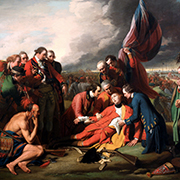
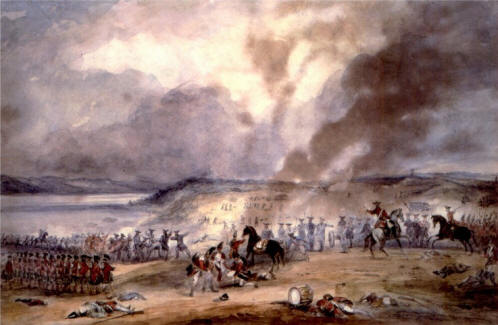
By the time Montcalm realized what had happened, it was too late. Wolfe's troops had ascended the cliffs and assembled on the Plains of Abraham, just outside the city walls. Montcalm quickly gathered his forces and marched out of the city to confront the British. The ensuing Battle of the Plains of Abraham was short but brutal. In less than an hour, both Montcalm and Wolfe were mortally wounded, and the French forces were decisively defeated. With the fall of Quebec City, the dream of a French empire in North America was effectively over. New France, which had stood for centuries as a bastion of French culture and influence, crumbled in the face of British military superiority.
The fall of Quebec had profound implications not only for the French but for the future of Canada. The victory at Quebec allowed the British to take control of the entirety of New France, and by 1763, the Treaty of Paris would formally end French rule in North America. While the French inhabitants of Canada were allowed to retain their language, religion, and civil law under British rule, the political and military power of France was gone. This marked the beginning of British dominance in what would eventually become Canada.
However, the British victory in North America also had unintended consequences. With the French threat eliminated, the British colonies along the eastern seaboard no longer felt the need for British protection. As Britain sought to exert greater control over its colonies to pay off war debts, tensions grew between the Crown and its American subjects, ultimately leading to the American Revolution. Canada, now a British colony, would find itself facing new challenges as Loyalists fleeing the American Revolution sought refuge in the northern territories, further shaping the demographic and political landscape of the region. The fall of Quebec and the British victory in the Seven Years' War set the stage for the creation of modern Canada, a nation that would be shaped by both its French and British heritage.
Cite Article : www.canadahistory.com/sections/documents