CANADA HISTORY
Tommy Douglas stands as one of the most influential figures in Canadian history, not only for his pioneering role in politics but also for the transformative policies he implemented that shaped the country. His early experiences growing up on the prairies during the volatile periods of the Roaring Twenties and the Great Depression instilled in him a deep understanding of the struggles faced by ordinary people. Douglas' rise to prominence as the first leader of a socialist government in North America, and his legacy as the architect of Medicare in Canada, mark him as a visionary whose policies continue to have far-reaching impacts.
Born in 1904 in Falkirk, Scotland, Douglas and his family immigrated to Winnipeg, Manitoba, in 1910. His early years were marked by poverty, and a bone infection almost led to the amputation of his leg. This experience shaped his deep belief in the need for accessible healthcare—a belief that would later define his political career. After working various jobs and overcoming personal hardships, Douglas attended Brandon College, where he pursued a degree in theology. During this time, he earned extra money by delivering sermons on Sundays, often focusing on social justice and the need for government intervention to support those struggling during the Great Depression.
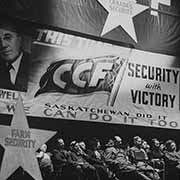
Douglas was drawn to the Co-operative Commonwealth Federation (CCF), a political party formed in 1932 during the height of the Depression. The CCF was built on socialist principles, advocating for government control of key industries, public ownership of utilities, and the implementation of social safety nets. These ideas resonated with Douglas, who had witnessed the suffering and inequality that capitalism, left unchecked, had wrought on the prairies. He first ran for federal office in 1935 and won a seat in the House of Commons, representing the CCF. Douglas became one of seven CCF MPs sent to Ottawa, marking the beginning of his long and storied political career.
However, it was in Saskatchewan that Douglas truly made his mark. In 1942, he was elected leader of the provincial CCF, and in 1944, his party won a landslide victory, securing 47 of 53 seats in the Saskatchewan Legislature. This election made Douglas the first leader of a socialist government in Canada or the United States, a groundbreaking achievement in a political landscape historically dominated by more conservative, capitalist ideologies. His victory was not only a triumph for the CCF but also a reflection of the growing demand for social reform and government intervention in the wake of the Great Depression.
As Premier of Saskatchewan, Douglas wasted no time implementing his progressive vision for the province. One of his first actions was to establish the Saskatchewan Power Corporation, a publicly owned utility that extended power lines to rural and isolated communities across the province. At a time when most rural farms had no access to electricity, this move was transformative, bringing modern amenities to thousands of Saskatchewan residents and improving the quality of life in rural areas.
Douglas also passed a series of groundbreaking human rights bills. His government implemented the Bill of Rights Act in 1947, which was one of the first of its kind in Canada and served as a model for later human rights legislation. Under his leadership, the CCF worked to unionize the public service, giving workers the ability to collectively bargain and secure better working conditions and wages. Douglas’s government also nationalized various industries, including transportation, insurance, and telecommunications, reflecting his belief that public ownership of key services was essential to ensuring that everyone had equal access to them.
The most enduring aspect of Douglas’s legacy, however, was his healthcare reforms. In 1947, his government introduced free hospital care for the residents of Saskatchewan, a revolutionary policy at the time. This initiative was a precursor to the full-scale Medicare system that Douglas would later implement. In 1961, Saskatchewan became the first province in Canada to establish universal Medicare, providing free medical care to all its citizens, regardless of income. This model of healthcare became the blueprint for a national healthcare system, which was later adopted by the rest of Canada in 1966 under the federal government’s Medical Care Act.
Douglas’s commitment to Medicare was born out of personal experience. His childhood brush with amputation, narrowly avoided because a surgeon offered to treat him for free, had left an indelible mark on him. He believed that healthcare should be a basic human right, not a privilege reserved for the wealthy. His tireless advocacy for Medicare, even in the face of fierce opposition from the medical establishment and political rivals, eventually won over the people of Saskatchewan and, later, Canada as a whole. Today, universal healthcare is one of the defining characteristics of Canadian society, and it remains a cornerstone of the country’s social welfare system.
One of the most striking aspects of Douglas’s tenure as Premier was his ability to balance social reform with fiscal responsibility. Despite the ambitious nature of his government’s policies, the CCF managed to reduce the provincial deficit left by the previous government. Through careful management, Douglas’s government not only brought Saskatchewan’s finances under control but also produced yearly budget surpluses, countering the predictions of his critics who had claimed that his socialist policies would lead to financial ruin.
Douglas's success in Saskatchewan paved the way for the broader adoption of his ideas across Canada. His impact was not limited to healthcare. His belief in the role of government as a force for good, his emphasis on public ownership, and his commitment to human rights and social equality had a profound influence on Canadian politics. The rise of the New Democratic Party (NDP), which emerged from the CCF in 1961, ensured that his vision for a more equitable society would continue to be part of the national dialogue.
Douglas's contributions earned him the recognition as the "Father of Medicare", and in 2004, he was voted as the "Greatest Canadian" in a nationwide CBC poll, underscoring the lasting impact of his leadership. His blend of progressive social policy, fiscal prudence, and unwavering commitment to equality not only reshaped Saskatchewan but also left a permanent mark on Canada as a whole.
In conclusion, Tommy Douglas’s legacy is one of bold, transformative leadership. He not only revolutionized healthcare in Canada but also demonstrated that government could be a force for positive social change. His policies, especially Medicare, continue to define Canada’s national identity as a country that values the well-being of all its citizens. His achievements in Saskatchewan served as a model for the nation, and his commitment to equality, fiscal responsibility, and social welfare have had a profound and lasting impact on Canadian history.
Cite Article : www.canadahistory.com/sections/documents