CANADA HISTORY
The Long Telegram of February 22, 1946, authored by George Kennan, a U.S. diplomat stationed in Moscow, marked a pivotal moment in the Cold War. Kennan's analysis of Soviet intentions provided a strategic framework for American foreign policy and set the stage for what would become the Doctrine of Containment. His assessment argued that the Soviet Union, driven by its expansionist ideology, was determined to spread its influence globally. The Telegram warned that, left unchecked, Soviet ambitions would threaten Western democracies. However, Kennan believed that if Soviet expansion could be contained within its existing borders, the regime would eventually collapse under its internal contradictions. This analysis became the foundation of U.S. foreign policy for decades, shaping its approach to global affairs during the Cold War.
The implications of Kennan's Long Telegram were profound, particularly in how the West viewed Soviet actions in the years that followed. The U.S., Canada, and other allied nations adopted the Doctrine of Containment, a policy that sought to prevent Soviet influence from spreading. This policy would significantly impact Canada’s role on the global stage, particularly in the Korean War. The conflict in Korea would become a major test of the West’s commitment to Kennan’s vision of containment, and Canada played a crucial role in supporting the international effort to resist communist aggression.
In 1950, just a few years after Kennan’s telegram, tensions flared in the Korean Peninsula. On January 12 of that year, U.S. Secretary of State Dean Acheson gave a speech in which he outlined America's defense perimeter in the Pacific, but controversially did not mention South Korea. This omission may have been interpreted by the Soviet Union and its communist allies as an indication that the U.S. would not intervene militarily if South Korea were attacked. On June 25, 1950, North Korean forces, backed by Soviet and Chinese support, launched a surprise invasion of South Korea, triggering the Korean War.
The invasion caught the international community off guard. At the time, the Soviet Union was boycotting United Nations Security Council (UNSC) meetings in protest of the council's refusal to recognize the People’s Republic of China (PRC), the communist government of mainland China, and instead granting a seat to the Republic of China (Taiwan). This boycott allowed the Western powers to pass UNSC Resolution 82, which condemned North Korea as the aggressor in the conflict and called for international military support for South Korea. Crucially, the Soviet absence meant that they could not veto the resolution, enabling the United Nations to act decisively in response to the invasion.
On June 27, 1950, U.S. President Harry Truman ordered immediate military assistance to South Korea, framing the conflict as part of the broader struggle to contain communism. The United Nations, for the first time, mobilized a multinational military force to respond to an act of aggression, setting an important precedent for collective security in the post-World War II era.
Canada, under the leadership of Prime Minister Louis St. Laurent, was quick to respond to the crisis. On June 28, 1950, Lester Pearson, Canada’s ambassador to the United Nations, voiced strong support for UNSC Resolution 82. Canada recognized that this conflict represented more than a regional dispute—it was a test of the Western powers’ commitment to containing communism and upholding the principles of international law.
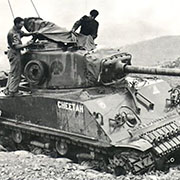
Canada's contributions to the Korean War were substantial and represented a significant commitment to the United Nations' effort. Initially, Canada offered three destroyers and an air transport squadron to assist in the United Nations military operations. This contribution was later expanded to include a much larger land force, beginning with the 2nd Battalion of the Princess Patricia’s Canadian Light Infantry (PPCLI). Over the course of the war, more than 21,940 Canadian Army personnel and 3,600 naval personnel served in Korea, marking Canada's first military engagement since World War II.
The Korean War was a brutal and costly conflict. By the time a ceasefire was declared in 1953, over 312 Canadian soldiers had been killed in action, and 1,202 had been wounded. Despite the heavy toll, the United Nations forces, including Canada, had successfully defended South Korea from falling entirely into communist hands. The war ended in an uneasy armistice, with the Korean Peninsula still divided along the 38th parallel, a division that persists to this day. Although no formal peace treaty was signed, the outcome was seen as a victory for containment, and it demonstrated the resolve of the Western powers, including Canada, to resist communist expansion through military means if necessary.
Canada’s involvement in the Korean War solidified its role as a committed member of the international community and as a key ally in the Western bloc during the Cold War. The conflict reinforced the importance of collective security and multilateralism, principles that Canada had long supported. The war also marked a new chapter in Canada-U.S. relations, as the two nations cooperated closely within the framework of the United Nations. Canada’s contributions to the Korean conflict reflected its willingness to engage in global affairs and support international efforts to maintain peace and security.
The lessons learned from the Korean War had a lasting impact on Canadian foreign policy. Lester Pearson, who had played a pivotal role in garnering Canadian support for the United Nations action in Korea, later used his experience to broker peace during the Suez Crisis in 1956. His efforts in that crisis earned him the Nobel Peace Prize and reinforced Canada’s reputation as a peacekeeping nation. The Korean War thus became a cornerstone in Canada’s post-war foreign policy, shaping its future approach to international conflicts and its participation in United Nations peacekeeping missions.
The Korean War also had broader implications for the Cold War. It marked the first time that the United Nations had deployed a multinational force in response to an act of aggression, setting an important precedent for future UN interventions. The war also solidified the Doctrine of Containment as the guiding principle of Western foreign policy during the Cold War. The United States, with the support of its allies, including Canada, demonstrated that it was willing to use military force to resist communist expansion, sending a clear message to the Soviet Union and China that the West would not tolerate further acts of aggression.
In conclusion, the Korean War, catalyzed by George Kennan’s Long Telegram and the Doctrine of Containment, was a pivotal moment in the early Cold War. It tested the resolve of the Western powers to stand firm against the spread of communism, and Canada’s significant contributions to the conflict demonstrated its commitment to the principles of collective security and international cooperation. The war also had lasting impacts on Canadian foreign policy, shaping the nation’s role in global affairs for decades to come. For Canada, the Korean War was not only a military engagement but a defining moment that helped solidify its identity as a middle power committed to peace, stability, and multilateralism on the world stage.
Cite Article : www.canadahistory.com/sections/documents