CANADA HISTORY
When Pierre Trudeau was elected as the Member of Parliament for Mount Royal in Montreal in 1965, few could have predicted the impact he would have on Canadian politics. Trudeau entered Parliament at a time of significant political, social, and cultural change in Canada. By the mid-1960s, Canada had recently celebrated its centennial, but it was also a country facing increasing uncertainty. The Quiet Revolution was transforming Quebec, stirring questions about the province's role in Confederation, while nationalism and separatism simmered beneath the surface. Amidst this backdrop of change and unease, Trudeau's rise to power as a dynamic and visionary leader came at just the right time, resonating with a population eager for new leadership that could both embrace change and preserve national unity.
Trudeau’s Early Political Career
When Trudeau arrived in Ottawa in 1965, he was part of a new wave of Quebecers recruited by Prime Minister Lester B. Pearson to help modernize the Liberal Party and address the growing nationalist movement in Quebec. Trudeau was quickly recognized for his intellect, wit, and charisma, and within two years, he was appointed Minister of Justice in Pearson's government. As Justice Minister, Trudeau championed progressive policies that would come to define his political philosophy. He decriminalized homosexuality and reformed Canada’s divorce laws, famously stating that "the state has no place in the bedrooms of the nation."
Trudeau's rapid rise through the political ranks came at a time when Canada was grappling with deep political divisions. The country had endured three consecutive minority governments, and neither Robert Stanfield, the new leader of the Progressive Conservative Party, nor Pearson himself seemed capable of inspiring the confidence and enthusiasm of the Canadian electorate. Moreover, the country was witnessing the political and social upheavals of the 1960s, from the civil rights movement in the United States to the rise of youth counterculture around the world. In Quebec, the Quiet Revolution was reshaping society, pushing for secularism, economic modernization, and greater provincial autonomy, while also fostering a growing sense of Quebecois nationalism.
Pearson Steps Aside, Trudeau Steps In
By 1967, Pearson had decided that he would not lead the Liberal Party into another election. Recognizing the need for fresh leadership, Pearson stepped aside, setting the stage for a highly contested Liberal leadership race. After much deliberation, Pierre Trudeau entered the race, bringing with him a vision for a Just Society—a concept that would come to define his political career. This vision centered on the idea of a pluralistic and inclusive society, where individual freedoms were protected, and where diversity was celebrated. Trudeau’s emphasis on bilingualism and multiculturalism resonated with many Canadians, particularly in Quebec, where tensions between the French- and English-speaking populations were growing.
As Trudeau prepared to address the Liberal Party’s leadership convention in 1968, the world was struck by the assassination of Martin Luther King Jr. on the eve of his speech. The tragic event cast a shadow over the convention, but it also gave Trudeau’s message a profound sense of urgency. In his speech, Trudeau called for a Canada where freedom and equality were the bedrock of society—a society where individuals could pursue their aspirations without fear of discrimination or oppression. His message of unity, inclusiveness, and justice struck a chord with the delegates, and Trudeau’s charismatic delivery captivated the country. His Kennedy-like persona, youthful energy, and intellectual rigor made him a political star overnight. Trudeau won the leadership and was sworn in as Prime Minister of Canada.
The Birth of Trudeaumania
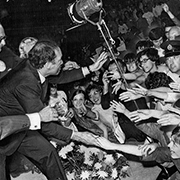
Once installed as Prime Minister, Trudeau wasted no time in calling a federal election. The election campaign that followed was unlike any in Canadian history. Trudeau quickly became a political celebrity, drawing massive crowds wherever he went. His youth, charm, and progressive ideas captivated Canadians, and a phenomenon dubbed "Trudeaumania" swept the nation. People flocked to see him speak, and his appeal transcended traditional political boundaries. Young Canadians, in particular, were drawn to his vision of a modern, progressive Canada. Trudeau’s idea of a Just Society, with its promise of social justice, equality, and a robust federalism that would balance the aspirations of Quebec with the needs of the entire country, resonated deeply.
Trudeau’s appeal extended beyond the content of his policies—his personal style and public image played an equally important role. He was often seen in the media engaging in judo, wearing fashionable outfits, or driving his signature Mercedes convertible. This combination of intellect, charisma, and style made him a symbol of Canada’s potential to be bold, modern, and forward-looking.
The St. Jean Baptiste Day Parade: A Defining Moment
As the election campaign reached its climax, Trudeau faced a defining test of his leadership during the St. Jean Baptiste Day Parade in Montreal on June 24, 1968. The parade, held in honor of Quebec's patron saint, had become a politically charged event, as tensions between separatists and federalists reached a boiling point. As Trudeau and other officials sat in the grandstand, a group of Quebec nationalists began throwing rocks and bottles at the dignitaries in an attempt to disrupt the event and intimidate the federal government.
While others ducked for cover, Trudeau famously refused to back down. He remained in his seat, unflinchingly defying the protesters. His act of courage and defiance was broadcast across the country, and it left a powerful impression on the Canadian public. In that moment, Trudeau demonstrated that he was not only a leader of intellect and vision but also one of principle and resolve. His refusal to be intimidated by extremists was seen as a defining moment of leadership, and it helped solidify his image as a strong and capable leader willing to stand up to threats to Canadian unity.
A Majority Government and Trudeau’s Legacy
The next day, Canadians went to the polls, and Trudeau led the Liberal Party to a majority government, winning 154 seats in the House of Commons. His victory marked the beginning of a new era in Canadian politics, one defined by Trudeau’s vision of a Just Society, in which all Canadians would be equal under the law, and the federal government would play an active role in promoting social justice and national unity.
Trudeau’s first term in office saw him implement policies aimed at transforming Canada into a more inclusive and bilingual nation. His Official Languages Act, passed in 1969, made French and English Canada’s two official languages, ensuring that services would be available in both languages across the country. This was a crucial step in addressing the tensions between Quebec and the rest of Canada, and it cemented Trudeau’s legacy as a champion of bilingualism.
Trudeau also laid the groundwork for future social policies that would define Canada’s national identity, including his support for multiculturalism as an official policy in 1971. His commitment to protecting individual rights was further solidified with the introduction of the Canadian Charter of Rights and Freedoms in 1982, during his second stint as Prime Minister, ensuring that all Canadians would be protected by law from discrimination and injustice.
Trudeau’s Legacy in Canadian History
Pierre Trudeau’s rise to power in the late 1960s marked a turning point in Canadian history. His vision of a Just Society, his commitment to bilingualism, and his determination to preserve Canadian unity set the tone for a new era of progressive politics in Canada. His ability to channel the spirit of change that defined the 1960s into concrete political action helped reshape the country’s political landscape and solidified his place as one of Canada’s most influential leaders.
Trudeau’s legacy is particularly significant in the context of Quebec’s role in Confederation. His efforts to bridge the divide between Quebec and the rest of Canada, while not without their challenges and controversies, played a critical role in maintaining national unity during a time when separatist sentiment was on the rise. His steadfast commitment to federalism, as demonstrated during the October Crisis of 1970 and later during the 1980 Quebec referendum, helped prevent the country from fracturing.
In the broader context of Canadian history, Trudeau’s leadership represented a shift toward a more inclusive and egalitarian society. His advocacy for bilingualism, multiculturalism, and individual rights reflected a broader societal move away from colonial-era divisions and toward a more unified, forward-thinking vision of Canada. Though his policies were not without their critics, and his tenure was marked by moments of intense political conflict, Trudeau’s impact on Canada is undeniable. He remains one of the most iconic and transformative figures in the country’s history, and his contributions to shaping modern Canada continue to be felt today.
Cite Article : www.canadahistory.com/sections/documents