CANADA HISTORY
On September 1, 1939, the global political landscape shifted dramatically as Nazi Germany launched an unprovoked invasion of Poland, marking the beginning of the Second World War. For Canada, the next few days were a period of intense decision-making and mobilization. On September 3, Britain and France declared war on Germany, and though Canada was part of the British Empire, the country, due to the Statute of Westminster, was not automatically at war. As an independent nation, Canada had to make its own decision about whether to join the conflict. On September 10, after much debate, Canada officially declared war on Germany.
This marked the start of a significant transformation in Canadian history. In preparation for the war effort, the Canadian Defence Department activated Defence Scheme No. 3, which led to the mobilization of the Mobile Force. The initial challenge for Canada, however, was not simply whether to participate in the war but how to structure its contributions while balancing political pressures, especially the delicate issue of conscription that had deeply divided the country during the First World War.
Mackenzie King's Strategy: A Balancing Act
Canada's wartime Prime Minister, William Lyon Mackenzie King, had two primary concerns as the nation prepared for war. First, he wanted to avoid the massive losses in manpower and resources that had characterized Canada’s involvement in the First World War. Second, he needed to sidestep the politically charged issue of conscription, which had caused a national crisis during the previous war, especially in Quebec, where many French Canadians had resisted mandatory military service. King sought a compromise that would allow Canada to contribute to the war effort without repeating the bitter internal divisions of 1917. His solution was to emphasize air and naval power, relying on volunteers rather than conscripts for land forces.
Mackenzie King proposed that Canada’s war effort be directed toward creating a large Royal Canadian Air Force (RCAF) and expanding the Royal Canadian Navy (RCN). This strategy was a way to keep Canadian forces engaged in the conflict while reducing the likelihood of high casualties that might force the government to introduce conscription. This plan was practical, as it allowed Canada to leverage its geography and resources to support the war effort, while keeping the bulk of its army on Canadian soil initially.
The British Commonwealth Air Training Plan
One of the most significant contributions Canada made to the Allied war effort was the British Commonwealth Air Training Plan (BCATP). King’s strategy to emphasize air power materialized in the formation of this massive program. The BCATP was officially established in December 1939 and became the largest air training program in history. More than 250,000 men from various Commonwealth nations came to Canada to train as pilots, navigators, and other aircrew. By keeping these activities within Canadian borders, King achieved multiple goals: he contributed to the war effort while minimizing overseas deployment and avoided the necessity of conscription for land forces, at least temporarily.
The BCATP turned Canada into an aviation hub. Airfields and training schools were rapidly constructed across the country, and Canadian pilots who trained under the plan went on to serve in the Royal Air Force (RAF) and the RCAF, playing pivotal roles in the air war over Europe, especially during critical moments like the Battle of Britain and the strategic bombing campaigns over Germany.
The Expansion of the Royal Canadian Navy
In addition to its air force, Canada dramatically expanded its navy during the Second World War. Prior to the war, the Royal Canadian Navy was a small force with limited capabilities. However, as the war intensified, particularly in the Atlantic, the role of the Canadian Navy grew exponentially. By 1945, the RCN had become the third-largest navy in the world, after those of the United States and Great Britain. Canadian corvettes, destroyers, and frigates were vital in the Battle of the Atlantic, where they helped protect vital Allied convoys from the threat of German U-boats.
This transformation of the navy was one of Canada's major wartime successes. The growth of the RCN not only contributed to the Allied victory in the Atlantic but also marked Canada’s emergence as a naval power. By the end of the war, Canada’s navy had escorted thousands of merchant ships across the Atlantic, ensuring that supplies, troops, and equipment could reach the European front.
Mobilizing the Army: The First and Second Divisions
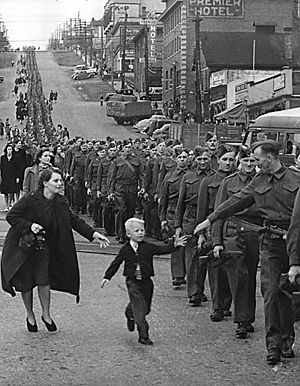
Although Mackenzie King preferred to emphasize the air and naval contributions, the realities of the war soon made it clear that land forces would be necessary. On September 19, 1939, the government announced plans to mobilize a single infantry division for overseas service, with a second division reserved for the defense of Canada. This decision reflected a cautious approach—King was wary of sending too many soldiers into combat and risking high casualties that might necessitate conscription. Nevertheless, over time, Canada’s army expanded significantly.
In the initial recruitment drive, about 61,500 men enlisted, with approximately 4,200 veterans of the First World War returning to service. However, recruitment was uneven. In Quebec, enlistment was slow. French Canadians were less enthusiastic about the war, seeing it as a conflict rooted in European imperial ambitions rather than a defense of Canada. They also viewed the military as predominantly English-speaking, which created further barriers to participation. Despite this, recruitment efforts continued, and training camps were established across the country to prepare soldiers for deployment overseas.
By December 1939, the 1st Canadian Infantry Division was ready for deployment and sailed from Halifax to Britain, where they would prepare for combat. The early months of the war, often referred to as the “Phony War,” allowed the Canadians to undergo extensive training and to build their strength while waiting for active deployment. Although they were initially sent to Scotland in April 1940 during the German invasion of Norway, they were not engaged in that campaign and returned to southern England to await the inevitable German offensive against France.
Building the Canadian War Machine
The mobilization of Canada’s armed forces, coupled with King’s emphasis on air and naval power, triggered a significant economic transformation at home. Factories were retooled to produce war materials—rifles, tanks, planes, and naval vessels—and the government implemented wage and price controls to prevent inflation. The war effort ended the Great Depression in Canada by creating jobs and stimulating industrial growth on an unprecedented scale.
The federal government also relied on the sale of Victory Bonds to finance the war. These bonds were marketed to the public as a way for ordinary Canadians to support the war effort, and bond drives became a popular way for communities across the country to feel involved in the national cause. Meanwhile, women played an essential role in the war economy, filling factory jobs vacated by men who had enlisted and contributing to the production of essential war materials. Women also served in various auxiliary roles in the military, marking the beginning of a significant shift in gender roles in Canada.
The Transformation of Canada: From Depression to War Economy
Canada’s participation in the Second World War was transformative. Before the war, Canada was still recovering from the effects of the Great Depression. The war effort not only revitalized the Canadian economy but also accelerated the country’s transformation from a primarily agrarian society to a modern industrialized nation. By 1945, Canada had become a significant player in the global economy, with a thriving manufacturing sector and a population that had shifted towards urban centers. The war laid the groundwork for the post-war prosperity that would define the country in the following decades.
The war also changed Canada's political and social landscape. Mackenzie King’s delicate balancing act between meeting the demands of the war effort and managing the political sensitivities surrounding conscription was largely successful. Although conscription eventually became necessary in 1944, King’s approach minimized the political fallout, particularly in Quebec, and maintained national unity during a time of immense pressure.
Canada’s Role in the Early Stages of World War II
Canada’s response to the outbreak of the Second World War marked the beginning of a new era in the country’s history. Under the leadership of Mackenzie King, Canada mobilized its forces cautiously but effectively, with an emphasis on air and naval power. The British Commonwealth Air Training Plan and the expansion of the Royal Canadian Navy were significant contributions to the Allied war effort, while the mobilization of the 1st and 2nd Divisions marked Canada’s commitment to the defense of Britain and the eventual liberation of Europe.
At home, the war effort transformed the economy, bringing an end to the Great Depression and laying the foundations for post-war prosperity. Canada’s involvement in the war also helped to forge a stronger sense of national identity, as the country moved from being a dominion within the British Empire to a nation capable of making its own decisions on the world stage. The events of 1939 and 1940, from the mobilization of the military to the expansion of the war economy, were pivotal in shaping Canada’s role in the global conflict and in the post-war world that followed.
Cite Article : www.canadahistory.com/sections/documents