CANADA HISTORY
By 1943, the strategic landscape of World War II was beginning to tilt decisively in favor of the Allied powers. The tide of war had shifted after significant defeats for the Axis forces, most notably the German retreat from El Alamein in North Africa and the devastating blow dealt to Hitler’s forces at Stalingrad. In the Pacific, the U.S. Navy and Marines had begun to turn the tide against Japanese forces. With these turning points marking the beginning of the end for Axis powers, the need for a unified and coordinated strategy among the Allies became more urgent.
It was against this backdrop that the Quebec Conference of 1943, codenamed QUADRANT, took place. This meeting was one of the most significant Allied conferences of the war and highlighted Canada’s increasing importance on the global stage. Canada, having stood by Britain since 1939, was not just a participant but a host to the leaders of the world's most powerful nations. The Quebec Conference served as a critical moment in shaping the final years of the war and solidifying post-war plans, with implications that would shape Canadian history and the global order for decades to come.
The Meeting of Allied Leaders in Canada: QUADRANT Conference
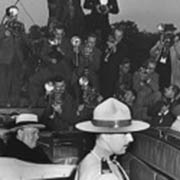
From August 11 to 24, 1943, three of the most powerful leaders of the Allied nations—Winston Churchill of Britain, Franklin D. Roosevelt of the United States, and Canada’s Prime Minister Mackenzie King—met at the Citadelle of Quebec and Château Frontenac in Quebec City. It was the first time that Canada, which had been engaged in the war since 1939, played host to such a crucial strategic meeting.
The location of Quebec for this conference was significant. Not only did it underline Canada’s integral role in the war, but it also highlighted the country's proximity to both the United States and the European theater of war. Canada had become a critical supplier of troops, munitions, food, and raw materials for the war effort, and its geographic position made it a bridge between the United States and Europe. Moreover, as a loyal member of the British Empire, Canada’s hosting of the conference underscored its position as a key player in shaping Allied strategies.
Strategic Discussions at the Quebec Conference
The central focus of the Quebec Conference was to determine the next major steps in defeating Nazi Germany and Imperial Japan. The Allied leaders were mindful that, despite recent victories, significant challenges lay ahead. Several major topics were discussed, which included the invasion of France, code-named Operation Overlord, which would eventually become the D-Day invasion of Normandy in 1944.
The leaders also reviewed the Mediterranean strategy, fresh off the success of Operation Husky, the invasion of Sicily, which had begun on July 10, 1943. The next steps included the decision to invade Italy, which Churchill famously referred to as the “soft underbelly” of Europe. This marked a turning point in the Mediterranean campaign, as the eventual fall of Italy would bring down one of the two key Axis powers in Europe.
In the Pacific, the Allies discussed continuing their push against the Japanese, who had been making gains in the region since 1941. The U.S. Navy and Marine Corps, along with British and Commonwealth forces, had begun to claw back strategic islands, and this conference helped define the next phases of operations.
The build-up of Allied troops in England also figured heavily in the discussions. This was crucial for the planning of Overlord, as the success of D-Day depended on a massive and carefully coordinated influx of men and materials. The bomber offensive in Europe, a key part of weakening Germany’s industrial and military capabilities, was another vital topic. Churchill and Roosevelt were committed to intensifying the bombing campaign over Germany to cripple its ability to fight and supply its military machine.
The leaders also discussed the support of partisans in the Balkans, recognizing that resistance movements in occupied Europe could tie down German forces and disrupt Axis supply lines. Similarly, the Battle of the North Atlantic, a crucial lifeline for the delivery of war materials from North America to Britain, was reviewed. The threat posed by German U-boats remained a significant concern, and strategies for ensuring the continued flow of resources across the Atlantic were solidified.
Establishing the South East Asia Command
Another critical decision made during the Quebec Conference was the establishment of a new theater of war: South East Asia Command (SEAC). The command was created to oversee Allied operations in Burma, India, and other parts of Southeast Asia, where Japanese forces were still making gains. Lord Louis Mountbatten was appointed as the Supreme Allied Commander of SEAC. This decision was a testament to the growing recognition of the Pacific as a key front in the war and the need for greater coordination in fighting the Japanese forces there.
The Quebec Agreement and the Atomic Bomb
Perhaps the most significant outcome of the Quebec Conference, and one that would profoundly shape the post-war world, was the signing of the Quebec Agreement. This agreement, signed by Churchill and Roosevelt, set the terms for the collaboration between the United States, Britain, and Canada in the development of nuclear weapons.
The development of the atomic bomb, codenamed the Manhattan Project, had been a closely guarded secret, with the Americans leading the effort. However, both Britain and Canada had important roles to play. British scientists had made significant contributions to nuclear research, and Canada’s supply of uranium, as well as its scientific expertise, were critical to the project. The Quebec Agreement formalized this partnership, ensuring that Canada and Britain would have a stake in the development of the atomic bomb. The agreement also outlined the terms under which atomic weapons could be used, specifying that neither country could use the bomb without the other’s consent.
This agreement was of immense importance not only to the outcome of the war but also to the geopolitical landscape of the post-war world. The collaboration on nuclear technology between the United States, Britain, and Canada would lay the groundwork for the Cold War and the nuclear arms race that followed. It also cemented Canada’s role as a key player in global scientific and military developments.
Canada’s Role in the Conference and Beyond
For Canada, the Quebec Conference was a defining moment in its wartime history. It was a recognition of Canada’s growing stature on the world stage and its integral role in the Allied war effort. Canada’s contributions to the war, both on the battlefield and in the production of materials, were essential to the success of the Allied cause.
Prime Minister Mackenzie King played the role of host and facilitator during the conference, ensuring that Canada was seen as a full partner in the discussions. Although he was not as actively involved in the military planning as Churchill and Roosevelt, King’s leadership was crucial in positioning Canada as a key member of the Allied alliance. By hosting the conference, Canada was acknowledged as a bridge between the United States and Britain, a position that would become even more important in the post-war world.
The conference also highlighted Canada’s scientific and industrial contributions to the war effort. The Quebec Agreement and Canada’s involvement in the development of nuclear technology were a testament to the country’s advanced scientific capabilities and its importance to the Allied cause. This would have lasting implications for Canada’s post-war development, as it became a leader in nuclear energy and research.
Conclusion: The Quebec Conference and its Lasting Legacy
The Quebec Conference of 1943 was a pivotal moment in World War II, marking a turning point in the Allies' strategic planning and ensuring the final defeat of the Axis powers. For Canada, the conference was a moment of validation, solidifying its role as a key player in the global war effort. Hosting the conference not only demonstrated Canada’s loyalty and commitment to the Allied cause but also positioned the country as a significant contributor to the strategic planning and technological advancements that would define the post-war world.
The Quebec Agreement, in particular, had far-reaching consequences. Canada’s involvement in the development of the atomic bomb underscored its importance in global scientific and military affairs, while also positioning the country as a partner in one of the most significant technological developments of the 20th century.
Ultimately, the Quebec Conference was a reflection of the changing dynamics of World War II and the critical role that Canada played in shaping the outcome of the war. As a result of this conference, Canada emerged not only as a loyal member of the British Empire but also as a burgeoning global power in its own right, with a lasting legacy in both the military and scientific fields.
Cite Article : www.canadahistory.com/sections/documents