CANADA HISTORY
As the march to war accelerated in 1939, the world was teetering on the edge of another great conflict. Nations scrambled to secure alliances, knowing that geopolitical tensions had reached a boiling point. The Nazi-Soviet Non-Aggression Pact, signed on August 23, 1939, was one of the most consequential and unexpected alliances in modern history. It shaped the early years of the Second World War, both in Europe and on the global stage, and its implications were deeply felt in Canada, altering the nation’s trajectory.
The background leading up to the Nazi-Soviet pact was fraught with diplomatic maneuvering. The Soviet Union, led by Joseph Stalin, was suspicious of both the fascist bloc and the western democracies. With Nazi Germany expanding aggressively and tensions with the West rising, Stalin sought an alliance that would safeguard Soviet interests. Earlier in 1939, the Soviet Union had reached out to Britain and France, proposing a defensive alliance to contain German aggression. However, these talks were half-hearted at best. British Foreign Secretary Lord Halifax was reluctant to fully engage, fearing that such an alliance would provide the Soviet Union an excuse to invade Poland. Britain sent a minor diplomat, Reginald Ranfurly Plunckett-Ernle-Erle-Drax, to handle negotiations, and in what many viewed as a diplomatic slight, he was sent by ship rather than by plane, causing significant delays.
During this time, Adolf Hitler was also seeking a strategic partnership. Though ideologically opposed to the Soviet Union, Hitler saw an opportunity to secure Germany's eastern front by striking a deal with Stalin. By neutralizing the Soviet Union, Hitler could focus his full attention on invading Poland and later turning against France and Britain. This approach would prevent Germany from fighting a two-front war, a mistake made during the First World War. Hitler, ever the opportunist, instructed his Foreign Minister Joachim von Ribbentrop to begin negotiations with the Soviets.
On August 23, 1939, the Nazi-Soviet Pact was signed. The world was stunned. For years, Nazi Germany and the Soviet Union had been ideological enemies: fascism versus communism. Yet now, the two powers had come to an agreement that was, at its core, deeply pragmatic. The public portion of the pact guaranteed that neither nation would attack the other for the next ten years. However, the secret protocols of the pact were far more consequential, as they divided Eastern Europe into spheres of influence. Poland was to be partitioned between the two, with Germany taking the western part and the Soviets occupying the east. The Baltic states—Estonia, Latvia, and Lithuania—would also fall into Soviet hands.
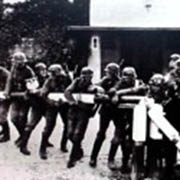
The signing of the Nazi-Soviet Pact removed any doubt that war was imminent. Germany now had the green light to invade Poland without fearing Soviet intervention. On September 1, 1939, Hitler launched his Blitzkrieg, or "lightning war," into Poland, swiftly overwhelming the country’s defenses. By October 6, the campaign was over, and Poland was divided between Germany and the Soviet Union, exactly as outlined in the secret agreement. The Nazi-Soviet pact had effectively set the stage for the beginning of the Second World War.
For Canada, the path to war was not immediate. Prime Minister William Lyon Mackenzie King, who had led Canada during much of the 1930s, was deeply apprehensive about being drawn into another European conflict. The horrors of the First World War, which had taken a significant toll on Canadian society, were still fresh in the national memory. Many Canadians, particularly in Quebec, were opposed to entering another war. The conscription crisis of 1917 had deeply divided the nation, and King was wary of repeating that experience.
As Hitler’s armies stormed into Poland, the Canadian government hesitated. King’s initial response was one of reluctance. He sought to limit Canada’s involvement to home defense and expressed to his ministers that Canada should focus on fortifying its shores rather than sending troops overseas. King’s caution was driven by political concerns, particularly the fear of alienating Quebec, where anti-war sentiment was strong.
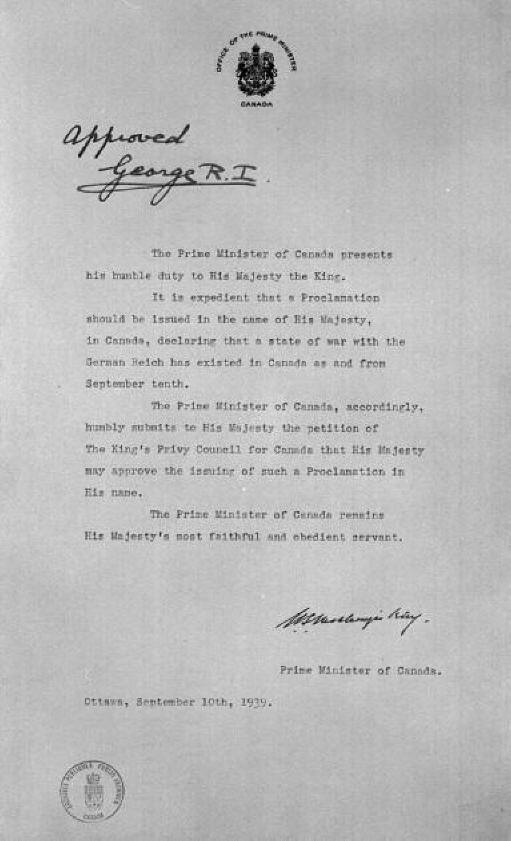
However, pressure soon mounted. Canada’s ties to Britain were deep, and the country’s role as a member of the British Empire meant that many English-speaking Canadians felt a moral obligation to join the fight. Canada’s military was small and under-equipped in 1939, but the public mood began to shift as the full scope of Germany’s aggression became clear. By September 7, King’s cabinet began to push for a more active role in the war. On September 10, 1939, after a week of parliamentary debate, Canada officially declared war on Germany. This was a pivotal moment, as it marked the first time Canada had declared war independently of Britain, underscoring the country’s newfound autonomy in foreign policy after the Statute of Westminster in 1931.
The mobilization of Canadian forces began immediately. While King had hoped to avoid sending large numbers of ground troops to Europe, focusing instead on building up the Royal Canadian Navy and the Royal Canadian Air Force, the realities of war soon shifted those plans. Canada would become an indispensable part of the Allied war effort, contributing significantly to the British Commonwealth Air Training Plan (BCATP) and the Battle of the Atlantic, among other key operations.
The Nazi-Soviet Pact had a lasting impact on the trajectory of the war. Hitler’s invasion of Poland brought Britain and France into the conflict, but the pact ensured that Germany would not have to fight on two fronts—at least not immediately. This allowed Germany to focus on Western Europe, leading to the rapid defeat of France in 1940 and the subsequent Battle of Britain. For Stalin, the pact bought the Soviet Union valuable time to rebuild and rearm after the purges of the 1930s had decimated its officer corps. However, the pact would not last. On June 22, 1941, less than two years after its signing, Hitler betrayed Stalin and launched Operation Barbarossa, the largest land invasion in history, against the Soviet Union.
For Canada, the Second World War would be a transformative experience. The country’s industrial and military contributions would earn it a new place on the world stage, and the war would accelerate the shift from an agrarian economy to an industrial powerhouse. The war also reshaped Canada’s domestic landscape, as the conscription crisis of 1944 once again exposed the deep divisions between English and French Canada. Yet despite these challenges, Canada emerged from the war with a stronger sense of national identity and a greater role in global affairs.
In conclusion, the Nazi-Soviet Pact and the outbreak of war in 1939 were turning points not only for Europe but also for Canada. While initially hesitant to become involved, Canada’s eventual participation in the Second World War marked the beginning of its emergence as a significant player on the international stage. The war would reshape the nation, forging a new sense of purpose and unity in the face of global conflict, while also highlighting the complexities of its internal divisions.
Cite Article : www.canadahistory.com/sections/documents